
Introduction
The EU Cyber Resilience Act (CRA) is not a usual, ‘run-of-the-mill’ IT security regulation. Previous EU cybersecurity regulations incorporated elements of the procedural standards ISO 27001 and ISO 27002. As with the Artificial Intelligence Act, the EU has adopted a quality assurance system approach in the CRA. However, the level of detail in the CRA goes much further. The CRA is a “formidable” set of requirements that is practically impossible to meet for micro, small and perhaps even medium-sized enterprises.
This document illustrates the ‘power’ of the CRA – the sheer volume of obligations that must be met. In this document, we have primarily sought to systematise and list the specific obligations of the various roles identified by the CRA, such as the manufacturer, importer, distributor and authorised representative. In some places, I also draw functional conclusions or pose questions.
Whilst compiling the document, I naturally made use of conversations with artificial intelligence services. I treated the responses from large language models (LLMs) merely as suggestions. In some parts of the document, I have left the AI’s responses verbatim.
This material may be helpful in drawing up a manufacturer’s internal procedures and agreements between the various parties involved in the process. However, these issues remain open to further interpretation and elaboration. The number of checkpoints arising directly from this CRA analysis alone is well above 200.
The ultimate conclusion is that this is a regulation tailor-made for large corporations and imposes requirements that micro, small and medium-sized enterprises are unable to meet in practice. References to proportionality and support options for micro and SMEs (small and medium-sized enterprises) are illusory. Fees for using notified bodies are to be determined on a proportionate basis. There is to be some sort of form to fill for micro-enterprises and SMEs, whilst amongst the support measures under Article 33 of the CRA the highlight is …a chat with the regulator.
Essentially, the procedural content of this regulation (apart from the empty declarations that ‘it must be secure’ – or, in fact, ‘with a level of security appropriate to the risk’) also suggests that no one really knows how to achieve cybersecurity in practice.. In my mind’s eye, I can see Ursula von der Leyen summoning her generals to an underground bunker in one of Europe’s capitals and ordering them to ensure that things are cybersecure. They then shift from one foot to the other, before looking at one another, wondering what it actually means to ensure security. Eventually, they break it down into the ‘front part of the crank’, the ‘middle part of the crank’ and the ‘back part of the crank’, all while scratching their heads. The CRA contains mostly procedural obligations. In this way, it answers the question of whether technological regulation can be technology-neutral. It can, but what’s the point? Add to that the comical references to technological espionage, where the ‘Usual Suspects’ are the US, Israel and China – in other words, the largest manufacturers of hardware and software. Are we not supposed to buy from them? And is it even possible to ensure cybersecurity in a globally interconnected digital world? This question was answered long ago by the authors of cyberpunk science-fiction, led by William Gibson. And reality, unfortunately, confirms their predictions.
Let us therefore take the content of paragraph 1 of Article 33, ‘Support measures for microenterprises, small and medium-sized enterprises, including start-ups’, as a summary of this rather lengthy introduction:
- Member States shall, where appropriate, undertake the following actions, tailored to the needs of microenterprises and small enterprises:
- a)organise specific awareness-raising and training activities about the application of this Regulation;
- b)establish a dedicated channel for communication with microenterprises and small enterprises and, as appropriate, local public authorities to provide advice and respond to queries about the implementation of this Regulation;
- c)support testing and conformity assessment activities, including, where relevant with the support of the European Cybersecurity Competence Centre.

Maciej Gawroński
maciej.gawronski@gppartners.pl
GP Partners Gawroński, Biernatowski sp.k. | 28, Emilii Plater Street, 00-688 Warsaw, Poland
1. CRA
Regulation (EU) 2024/2847 of the European Parliament and of the Council of 23 October 2024 on horizontal cybersecurity requirements for products with digital elements (Cyber Resilience Act).
2. What does the CRA do?
- The CRA introduces cybersecurity requirements for products with digital elements (PDEs), i.e. products containing software, including the software itself, at the stages of
- 1)product development
- 2)placing on the market
- 3)product maintenance (i.e. generally a minimum of 5 years from the date of placing on the market)
Exceptions:
- 1)if the software does not connect to a network, even indirectly
- 2)if the software does not install any components on the user’s device – pure IaaS, PaaS, SaaS (though management apps and associated services are more likely to do so)
Sectoral exemptions. The CRA also does not apply to (Article 2(2)–(4) of the CRA):
- 1)medical devices – Regulation (EU) 2017/745;
- 2)in vitro diagnostic medical devices – Regulation (EU) 2017/746;
- 3)motor vehicles and their trailers, as well as regulated systems and components – Regulation (EU) 2019/2144;
- 4)certified aeronautical products, parts and appliances – Regulation (EU) 2018/1139;
- 5)Marine equipment covered by the Directive 2014/90/EU.
3. Who does it apply to?
Who is subject to the CRA:
- 1)PDE manufacturers
- 2)manufacturers of new versions of PDE (sometimes developed by others)
- 3)importers of PDE
- 4)PDE distributors
- 5)authorised representatives of PDE manufacturers
- 6)contracting authorities and contracting entities subject to public procurement law (as Article 5 CRA expressly requires procurement contracts to comply with the CRA)
- 7)natural and legal persons other than manufacturers, importers or distributors who [1] make a substantial modification to a product with digital elements and [2] make that product available on the market (they are regarded as manufacturers)
- 8)other ‘economic operators’? This presumably refers to notified bodies, open-source software stewards, ‘economic operators who use PDE or who have ‘supplied’ a PDE to another economic operator (Article 23 of the CRA). But presumably also a ‘fulfilment service provider’ within the meaning of Regulation (EU) 2019/1020 (see below).
- NOTE the definition of ‘economic operator’ in Article 3(12) of the CRA.
- ‘Economic operator’ means the manufacturer, the authorised representative, the importer, the distributor or other natural or legal person who is subject to obligations in relation to the manufacture of products with digital elements or the making available on the market of products with digital elements in accordance with this Regulation’.
- Is a developer an ‘economic operator’? Presumably not per se, that is, provided that what they supply is not yet a PDE (i.e. it is not placed on the market by them under their own name or trademark).
- NOTE Article 52(1) of the CRA, which contains a ‘minor’ extension of the provisions, stating that ‘the provisions of Regulation (EU) 2019/1020 shall apply to products with digital elements falling within the scope of this Regulation.’ And Article 3.11 of that Regulation also refers to a ‘fulfilment service provider’, which means
- ‘means any natural or legal person offering, in the course of commercial activity, at least two of the following services: warehousing, packaging, addressing and dispatching, without having ownership of the products involved, excluding postal services as defined in point 1 of Article 2 of Directive 97/67/EC of the European Parliament and of the Council, parcel delivery services as defined in point 2 of Article 2 of Regulation (EU) 2018/644 of the European Parliament and of the Council, and any other postal services or freight transport services’
- These appear to be fulfilment operators such as Amazon FBA.
4. Who is exempt from the CRA?
- 1.In principle, the CRA does not apply directly to developers who do not make the relevant product available on the market under their own name or trademark.
- 2.The (relevant) obligations under the CRA should be transferred to developers contractually.
5. Why? Penalties (Article 64 of the CRA)
- 1.Why is compliance necessary? For money – that is, because of the penalties:
- a)€15 million / 2.5% – essential requirements, Articles 13 and 14 of the CRA – i.e. the manufacturer’s obligations
- b)€10 million / 2% – other obligations of all obligated entities, with the exception of (c)
- c)€5 million / 1% – incorrect, misleading or incomplete information provided to the authorities
- The higher amount applies: either the fixed sum or the percentage of global turnover from the previous year.
- In addition, the market surveillance authority may withdraw the product from the market.
- 2.Exceptions to penalties:
- 1)Micro and small enterprises: no penalty for a late (i.e. more than 24 hours) early warning regarding an actively exploited vulnerability or a severe incident. However, a penalty applies for a delayed notification (i.e. more than 72 hours).
- 2)Open-source stewards: no administrative penalties.
- 3.Penalties may be imposed on:
- a)the manufacturer
- b)the importer
- c)distributors
- d)the authorised representative
- e)the notified body and its subsidiaries and subcontractors – for breaches of their obligations
- and also
- f)‘other economic operators’ for providing false information at the request of the notified body or the market surveillance authority, which presumably refers to ‘fulfilment service providers’ under Regulation (EU) 2019/1020.
6. How long do these obligations last?
- 1.The CRA introduces a rather stringent period for maintaining PDE cybersecurity, namely essentially 5 years, and a period twice as long for retaining documentation and ensuring the availability of security updates – 10 years.
- 1)PDE support period: in principle, at least 5 years, except for products with a shorter expected use time (Article 13(8)).
- 2)Availability of each PDE security update: at least 10 years from release or until the end of the support period, whichever is longer (Article 13(9)).
- 3)Retention of technical documentation and EU declarations of conformity: 10 years or for the duration of the support period, whichever is longer (Article 13(13)).
- 2.Contractual recommendation: Contracts with developers should be amended so that the duration of their respective obligations matches the duration of the manufacturer’s obligations.
- 3.Long support periods, along with the requirement to retain documentation and ensure the availability of updates, place the importer in a difficult position if the manufacturer ceases trading or simply refuses to provide support. In such a situation, the importer may be forced to withdraw the product from the market and recall it from users.
7. Products with digital elements
7.1. Definition of a product with digital elements
In accordance with Article 3(1) of the CRA, read in conjunction with Article 2(1) of the CRA and the other definitions set out in Article 3 of the CRA, a product with digital elements (PDE) is a
- 1)computer software OR
- 2)computer hardware
- whose [in accordance with Article 2(1) of the CRA]
- the intended purpose or reasonably foreseeable use involves a direct or indirect, logical or physical data connection to a device or network
- and which are made available on the market (that is to say, supplied, whether for a fee or free of charge) for the purposes of distribution or use on the Union market in the course of a commercial activity
- AND
- 3)the associated remote data-processing solutions,
- including
- 4)software or hardware components which are placed on the market separately. This means that such separate components are also PDE
One would have to be as perverse as an EU bureaucrat for the most important definition in the entire act to consist of two provisions, without a formal reference to one of them (to Article 2 of the CRA), and an additional seven legal definitions, which we quote here:
- 2)‘remote data processing’ means the processing of data at a distance, for which the software is designed and developed by the manufacturer, or under the manufacturer’s responsibility, and the absence of which would prevent the product with digital elements from performing one of its functions;
- 4)‘software’ means the part of an electronic information system which consists of computer code;
- 5)‘hardware’ means a physical electronic information system, or parts thereof capable of processing, storing or transmitting digital data;
- 6)‘component’ means software or hardware intended for integration into an electronic information system;
- 22)‘making available on the market’ means the supply of a product with digital elements for distribution or use on the Union market in the course of a commercial activity, whether in return for payment or free of charge
- 23)‘intended purpose’ means the use for which a product with digital elements has been intended by its manufacturer, including the specific context and conditions of use, as indicated in the information provided by the manufacturer in the instructions for use, promotional or sales materials and statements, as well as in the technical documentation;
- 24)‘reasonably foreseeable use’ means a use which is not necessarily the intended purpose specified by the manufacturer in the instructions for use, promotional or sales materials and statements, as well as in the technical documentation, but which is most likely to result from reasonably foreseeable human behaviour, technical operations or interactions.
7.2. A web app is not a PDE
A web application (where, as I understand it, the code is executed on a server or on a server combined with code executed in the browser) is not a PDE.
https://cra.orcwg.org/official-guidance/#sct_2.sct_2

7.3. Pure SaaS, PaaS and IaaS are not PDEs either
Is there any SaaS left without an app or a plugin (e.g. for a browser)?
The most popular SaaS services have components on the user’s devices. For example:
- Gmail
- Google Docs
- Microsoft 365
- Canva
- Dropbox
- Zoom
- Salesforce
- ChatGPT
since they have an end-user component, the associated backend is ‘pulled’ into the PDE as ‘remote data processing solutions’.
Do, for example, the entire Microsoft 365 suite of services (following the outage on 12 November 2026, there are online proposals to rename the service to Microsoft 364) count as a PDE? For instance, does Exchange Online itself qualify as a PDE? It is, after all, a purely cloud-based service. But isn’t it designed to work with a range of PDEs (email clients)? So perhaps it does? Chat GPT initially claimed that Exchange Online is not a PDE, but upon further enquiry stated that it might be after all. Exchange Online is after all a ‘remote data processing solution’ linked to products with digital elements. Recital 12 of the CRA refers to ‘cloud solutions’:
- On the other hand, websites that do not support the functionality of a product with digital elements, or cloud services designed and developed outside the responsibility of the manufacturer of a product with digital elements do not fall within the scope of this Regulation.
Microsoft Exchange Online supports PDE functionalities. Therefore, a contrario, the CRA should apply to it.
As an example of a website that is not a PDE, Chat found me: “Overleaf — a cloud-based LaTeX document editor, used, amongst others, by academics” ¯\_(ツ)_/¯. Never heard of it. Well, we ourselves advise on the development and launch of new ‘purely cloud-based’ services. So, yes, such services do exist and, fortunately for them, they won’t be PDEs… unless they become the backend of a PDE (i.e. for example, if an app for a user’s device is released for such a service).
7.4. Product categories
The CRA divides PDEs into four categories: default, important Class I, important Class II and critical.
- 1)Default – all those that do not fall into the other categories (important Class I, important Class II and critical)
- They are subject to the self-assessment procedure (Module A*).
- *Annex II to Decision No 768/2008/EC of the European Parliament and of the Council of 9 July 2008 on a common framework for the marketing of products and repealing Council Decision 93/465/EEC (OJ L 218, 13.8.2008, p. 82) sets out the modules (A to H). CRA Article 32 and Annex VIII refer to modules A, B, C and H
- 2)Important – Class I
- Annex III lists: browsers, password managers, VPNs, operating systems, routers, smart home products with security functionalities.
- They are subject to self-assessment only where harmonised standards apply; otherwise, otherwise, the involvement of a notified body is required.
- 3)Important – Class II
- Annex III lists: hypervisors, container runtime systems, firewalls, IDS/IPS, tamper-resistant microprocessors.
- They must be assessed with the assistance of a notified body (Module B+C or H, or EUCC (i.e. the European Common Criteria-based Cybersecurity Certification Scheme))
- 4)Critical
- Annex IV lists: hardware devices with security boxes, smart meter gateways within smart metering systems, smartcards and similar devices including secure elements.
- Assessment: European certification, if required by a delegated act; otherwise, as for important Class II PDEs
Important Class I, important Class II and critical PDEs – all are directly or indirectly related to cybersecurity, as referred to in Articles 7 and 8 of the CRA.
8. CRA implementation timetable
8.1. Timetable
10 December 2024 – entry into force of the Regulation.
11 June 2026 – application of the provisions concerning notified bodies (Chapter IV).
11 September 2026 – commencement of obligations to notify authorities of actively exploited vulnerabilities and severe incidents under Article 14, including for products already on the market.
11 December 2027 – the CRA becomes fully applicable, in principle, including the essential requirements, conformity assessments and CE marking.
8.2. Transitional provisions
In accordance with Article 69(2) of the CRA,
- Products with digital elements that have been placed on the market before 11 December 2027 shall be subject to the requirements set out in this Regulation only if, from that date, those products are subject to a substantial modification
If we make a ‘substantial modification’ to an app or another of our PDEs, the new version will be subject to all CRA requirements. Could the 2028 New Year’s release be brought forward to 10 December 2027?
In accordance with Article 3(30),
- ‘substantial modification’ means a change to a product with digital elements following its placing on the market, which affects the compliance of the product with digital elements with the essential cybersecurity requirements set out in Part I of Annex I or which results in a modification to the intended purpose for which the product with digital elements has been assessed.
The definition is, in this sense, incomplete for the purposes of the initial assessment of the application of the CRA to a new version, in that the version prior to 11 December 2027 was not assessed at all against the CRA requirements. But in practice, the point is presumably that if we introduce a modification that does not affect the cybersecurity profile, we do not yet have to fall under the full CRA regime in relation to that PDE.
We must therefore certainly document the assessment of every modification to our PDE introduced from 11 December 2027 onwards, examining whether technological changes – particularly those relating to cybersecurity – as well as functional changes (e.g. the addition of new functionalities or the modification of existing ones) have an impact on cybersecurity, and specifically whether they increase the risk profile. This means that we must carry out a risk assessment for each such change. In this regard, the risk assessment requirements apply from 11 December 2027 to all changes, even if it is merely to establish that our PDE has not yet come under the full CRA regime.
9. PDE manufacturer
A ‘manufacturer’ within the meaning of the CRA means a natural or legal person who
- [1a]develops or manufactures products with digital elements, or
- [1b]has products with digital elements designed, developed or manufactured
- AND
- [2]markets them under its name or trademark (whether for payment, monetisation or free of charge).
10. Obligations of the manufacturer
10.1. An overview
- (1)Risk assessment: documented and kept up to date throughout the support period
- (2)Design and manufacture: in accordance with the essential requirements set out in Annex I
- (3)Due diligence: for third-party components, including open-source ones
- (4)Vulnerability in a component: report to the component steward, patch
- (5)Support period: vulnerability handling for a minimum of 5 years
- (6)Technical documentation: Annex VII, retained for at least 10 years
- (7)Conformity assessment, EU declaration, CE marking
- (8)User information: Annex II, including end-date of the support period
10.2. Essential requirements (Annex I) – an overview
Part I – product
- (1)no known vulnerabilities that can be exploited
- (2)secure by default configuration, reset option
- (3)security updates, automatic by default (with opt-out)
- (4)access control, encryption, integrity
- (5)data minimisation and minimisation of the attack surface
- (6)event logging, secure data deletion
Part II – vulnerability handling
- (1)SBOM in machine-readable format, covering at the very least top-level dependencies. SBOM = software bill of materials, i.e. ‘a list of the basic components used in software production’
- (2)addressing and remediating vulnerabilities without delay
- (3)regular security testing and reviews
- (4)coordinated vulnerability disclosure (CVD) policy
- (5)contact details for reporting vulnerabilities
- (6)secure distribution of updates, free patches
10.3. Essential requirements and PDE documentation
10.4. Annex I CRA – Essential cybersecurity requirements – Process
PDE production process
- [1]design,
- [2]develop
- [3]manufacture
- in such a way as to ensure a level of cybersecurity appropriate to
- [4]the risk
Sounds brief? The checklists are below, and there are as many of them as… grains of sand in the desert.
10.5. Annex I – Essential cybersecurity requirements – Product
Annex I, Part I, point 2 of the CRA – a product with digital elements shall:
- a)be without [1] known exploitable vulnerabilities;
- b)be made available on the market with a [2] secure by default configuration, including [3] the possibility to reset the product to its original state, [4] unless otherwise agreed between manufacturer and business user in relation to a tailor-made PDE;
- c)ensure that [5] vulnerabilities can be addressed through [5] security updates, including, where applicable, through [6] automatic security updates that are installed within an appropriate timeframe [7] enabled as a default setting, with [8] a clear and easy-to-use opt-out mechanism, through [9] the notification of available updates to users, and [10] the option to temporarily postpone them;
- d)ensure [11] protection from unauthorised access by [12] appropriate control mechanisms, including but not limited to [13] authentication, identity or access management systems, and [14] report on possible unauthorised access;
- e)[15] protect the confidentiality of stored, transmitted or otherwise processed data, personal or other, such as [16] by encrypting relevant data at rest or in transit by state of the art mechanisms, and [17] by using other technical means;
- f)protect the [18] integrity of stored, transmitted or otherwise processed data, personal or other, commands, programs and configuration against any manipulation or modification not authorised by the user, and [19] report on corruptions;
- g)process [20] only data, personal or other, that are adequate, relevant and limited to what is necessary in relation to the intended purpose of the product with digital elements (data minimisation);
- h)protect the [21] availability of essential and basic functions, [22] also after an incident, [23] including through resilience and mitigation measures against denial-of-service attacks;
- i)[24] minimise the negative impact by the products themselves or [25] connected devices on the availability of services provided by other devices or networks;
- j)be designed, developed and produced to [26] limit attack surfaces, including [27] external interfaces;
- k)be designed, developed and produced to [28] reduce the impact of an incident using [29] appropriate exploitation mitigation mechanisms and techniques;
- l)[30] provide security related information by [31] recording and monitoring relevant internal activity, including [32] the access to or modification of data, services or functions, with [33] an opt-out mechanism for the user;
- m)provide [34] the possibility for users to securely and easily remove on a permanent basis all data and settings and, [35] where such data can be transferred to other products or systems, ensure that this is done in a secure manner.
10.6. Annex VII – Technical documentation
- 1.Ten year retention. Technical documentation must be retained for 10 years or the support period, if the support period is longer than 10 years.
- 2.Apart from the manufacturer, the importer and the authorised representative are obliged to retain the technical documentation and ensure that it can be made available to these bodies upon request. The CRA does not explicitly require the distributor to hold the technical documentation, but how else is the distributor supposed to fulfil the obligation to verify that the manufacturer and importer have complied with the obligations set out in Article 13(15), (16), (18), (19) and (20), and Article 19(4), and have provided all the necessary documents to the distributor (Article 20(2)(b) of the CRA), especially if the manufacturer uses self-assessment rather than certification by a notified body?
- 3.The technical documentation must include all relevant data or details of the means used by the manufacturer to ensure that the product with digital elements and the processes put in place by the manufacturer comply with the essential cybersecurity requirements set out in Annex I, at least contain the elements set out in Annex VII (Article 31(1))
- 4.The technical documentation should be continuously updated at least during the support period (Article 31(2))
- 5.Technical documentation requirements resulting from Annex VII:
- 1)[1] a general description of the product with digital elements, including:
- a)[2] its intended purpose;
- b)[3] versions of software affecting compliance with essential cybersecurity requirements;
- c)[4] where the product with digital elements is a hardware product, photographs or illustrations showing external features, markings and internal layout;
- d)[5] user information and instructions as set out in Annex II;
- 2)[6] a description of the design, [7] development and [8] production of the product with digital elements, and [9] vulnerability handling processes, including:
- a)[10] necessary information on the design and development of the product with digital elements, including, where applicable, [11] drawings and schemes and a description of the system architecture explaining how software components build on or feed into each other and integrate into the overall processing;
- b)[12] necessary information and [13] specifications of the vulnerability handling processes put in place by the manufacturer, including [14] the software bill of materials, [15] the coordinated vulnerability disclosure policy,[16] evidence of the provision of a contact address for the reporting of the vulnerabilities and [17] a description of the technical solutions chosen for the secure distribution of updates;
- c)[18] necessary information and specifications of the production and [19] monitoring processes of the product with digital elements, and [20] the validation of those processes;
- 3)[21] an assessment of the cybersecurity risks against which the product with digital elements is designed, developed, produced, delivered and maintained pursuant to Article 13, including [22] how the essential cybersecurity requirements set out in Part I of Annex I are applicable;
- 4)[23] relevant information that was taken into account to determine the support period pursuant to Article 13(8) of the product with digital elements;
- 5)[24] a list of the harmonised standards applied in full or in part the references of which have been published in the Official Journal of the European Union, common specifications as set out in Article 27 of this Regulation or European cybersecurity certification schemes adopted pursuant to Regulation (EU) 2019/881 pursuant to Article 27(8) of this Regulation, and, [25] where those harmonised standards, common specifications or European cybersecurity certification schemes have not been applied, descriptions of the solutions adopted to meet the essential cybersecurity requirements set out in Parts I and II of Annex I, including a list of other relevant technical specifications applied. [26] In the event of partly applied harmonised standards, common specifications or European cybersecurity certification schemes, the technical documentation shall specify the parts which have been applied;
- [27] Where certain essential cybersecurity requirements are not applicable to the product with digital elements, the manufacturer shall include a clear justification to that effect in that technical documentation (Article 13(4) sentence 3).
- 6)[28] reports of the tests carried out to verify the conformity of the product with digital elements and of the vulnerability handling processes with the applicable essential cybersecurity requirements as set out in Parts I and II of Annex I;
- 7)[29] a copy of the EU declaration of conformity;
- 8)[30] where applicable, the software bill of materials, further to a reasoned request from a market surveillance authority provided that it is necessary in order for that authority to be able to check compliance with the essential cybersecurity requirements set out in Annex I.
- Attention: Point 8 of the Annex VII falsely suggests that SBOM is required in the technical documentation only when a market surveillance authority desires so. But point 2(b) requires SBOM in every case.
- 1)[1] a general description of the product with digital elements, including:
10.7. Annex II Information and instructions to the user
The information and instructions to the user must contain:
- 1)[1] the name, registered trade name or registered trademark of the manufacturer, and [2] the postal address, the [3] email address or other digital contact as well as, where available, [4] the website at which the manufacturer can be contacted;
- 2)[5] the single point of contact where [6] information about vulnerabilities of the product with digital elements can be reported and received, and where [7] the manufacturer’s policy on coordinated vulnerability disclosure can be found;
- 3)[8] name and type and any additional information enabling the unique identification of the product with digital elements;
- 4)[9] the intended purpose of the product with digital elements, including [10] the security environment provided by the manufacturer, as well as [11] the product’s essential functionalities and [12] information about the security properties;
- 5)any [13] known or foreseeable circumstance, related to the use of the product with digital elements in accordance with its intended purpose or [14] under conditions of reasonably foreseeable misuse, which may lead to significant cybersecurity risks;
- 6)where applicable, [15] the internet address at which the EU declaration of conformity can be accessed;
- 7)[16] the type of technical security support offered by the manufacturer and [17] the end-date of the support period during which users can expect vulnerabilities to be handled and receive security updates;
- 8)[18] detailed instructions or an internet address referring to such detailed instructions and information on:
- a)[19] the necessary measures during initial commissioning and throughout the lifetime of the product with digital elements to ensure its secure use;
- b)[20] how changes to the product with digital elements can affect the security of data;
- c)[21] how security-relevant updates can be installed;
- d)[22] the secure decommissioning of a product with digital elements, including
- [23] information on how user data can be securely removed;
- e)[24] how the default setting enabling the automatic installation of security updates, as required by Part I, point (2)(c), of Annex I, can be turned off;
- f)where the product with digital elements is intended for integration into other products with digital elements, [25] the information necessary for the integrator to comply with the essential cybersecurity requirements set out in Annex I and [26] the documentation requirements set out in Annex VII.
- 9)If the manufacturer decides to make available the software bill of materials (SBOM) to the user, [27] information on where that bill of materials can be accessed.
10.8. Cybersecurity risk assessment (13(2)-(4) CRA)
- 1.Manufacturers shall undertake an assessment of the cybersecurity risks associated with a product with digital elements and take the outcome of that assessment into account during the
- 1)planning
- 2)design
- 3)development
- 4)production
- 5)delivery
- 6)maintenance phases of a product with digital elements
- with a view to
- 1)minimising cybersecurity risks
- 2)preventing incidents
- 3)minimising the impact of incidents, including in relation to the health and safety of users
- 2.Risk assessment should be a documented process that is also updated during the support period (which is generally a minimum of 5 years), in accordance with 13(3) CRA. The risk assessment should therefore be a continuous process.
- 3.The risk assessment shall comprise of a risk analysis based on
- 1)the intended purpose
- 2)reasonably foreseeable use
- 3)the conditions of use of the PDE, such as [4] the operational environment, or
- 4)the assets to be protected, taking into account
- 5)the length of time the product is expected to be in use.
- 4.The cybersecurity risk assessment shall indicate
- 1)whether and, if so in what manner, the security requirements set out in Part I, point (2), of Annex I are applicable to the relevant product with digital elements
- 2)how those requirements are implemented as informed by the cybersecurity risk assessment
- 3)how the manufacturer is to apply Part I, point (1), of Annex I
- 4)the vulnerability handling requirements set out in Part II of Annex I.
- 5.The risk assessment shall be included in the PDE technical documentation.
10.9. Third-party components (13(5) and 13(6) CRA)
- 1.Manufacturers shall exercise [1] due diligence when [2] integrating into the PDE
- 1)components sourced from third parties, including
- 2)FOSS (free and open-source software) components that have not been made available on the market in the course of a commercial activity
- so that [3] they do not compromise the PDE’s cybersecurity.
- How should due diligence be carried out? Should a risk analysis be conducted? What about a certificate of conformity or technical documentation? And what about FOSS?
- 2.Vulnerabilities in third-party components (13(6) CRA)
Upon identifying a vulnerability in (any) third-party component, the manufacturer
- 1)shall report the vulnerability to the person or entity manufacturing or maintaining the component
- 2)shall address and remediate the vulnerability in accordance with the vulnerability handling requirements set out in Part II of Annex I.
- Annex I, Part II, point 2 of the CRA:
- in relation to the risks posed to products with digital elements, address and remediate vulnerabilities without delay, including by providing security updates; where technically feasible, new security updates shall be provided separately from functionality updates;
- This appears to suggest that the obligation to independently rectify vulnerabilities in third-party components only arises once the PDE has been placed on the market. This would be more logical, although the need to rectify third-party software and hardware remains an ambitious requirement in any case.
- 3)if they have developed a software or hardware modification to address the vulnerability in that component, they shall share the relevant code or documentation with the person or entity manufacturing or maintaining the component, where appropriate in a machine-readable format.
- So, if we have fixed someone else’s product, we have to tell them how we did it. The CRA is silent on remuneration. Therefore, if we intend to use someone else’s component in our PDE, it would be advisable to set out the terms of such ‘doing someone else’s work’ in the contract, e.g. in the liability section.
10.10. Conditions for placing a PDE on the market (13(12) CRA)
- 1.In order to place a PDE on the market, the manufacturer must ensure that the following are in place:
- 1)technical documentation
- 2)chosen [of course taking into account regulatory requirements] conformity assessment procedures
- 3)the EU declaration of conformity and CE marking.
- 2.CE marking is not required for spare parts, non-commercial FOSS, PDEs manufactured before 11 December 2027, prototypes and test versions (beta), or in-house systems (as these are not made available on the market. However, NOTE that they must not be a component of any other PDE already made available to the market to benefit from the exemption)
10.11. PDE conformity assessment
- 10.11.1.Obligation to carry out conformity assessment
- 1.In accordance with Article 32(1) of the CRA, the manufacturer is obliged to perform a conformity assessment of the product with digital elements.
- 2.There are currently three conformity assessment procedures available:
- 1)Internal control = internal control + EU declaration of conformity (self-certification) PDE = Annex VIII, Part I, Module A
- 2)EU-type examination = internal control + type certification of the product with digital elements and the vulnerability handling processes with the assistance of a notified body (EU-type examination certificate) + internal control and self-certification of products conforming to the certified type
- = Annex VIII, Part II, Module B + Part III, Module C
- 3)Full quality assurance = Internal audit + quality management system certification (approval and surveillance) + EU declaration of conformity (self-certification) = Annex VIII, Part IV, Module H
There is to be a fourth option:
- 4)a European cybersecurity certification scheme – as devised by the Commission.
- 3.Which conformity assessment procedures may each manufacturer choose from?
- 1)A manufacturer of a ‘default’ PDE may use any conformity assessment procedure.
- 2)A manufacturer of an important Class I PDE may use self-certification (internal control) only if (Article 27 of the CRA) they apply the relevant harmonised standards, common specifications (those devised by the Commission) or certification schemes (those devised by the Commission).
- 3)A manufacturer of an important Class II PDE may not use Module A (i.e. full self-certification).
- 4)A manufacturer of a critical PDE – like an important Class II PDE – may do so unless the Commission devises a separate approval pathway for that PDE.
- 4.What do these Modules A, B, C, and H actually entail? They are defined in Annex II to Decision No 768/2008/EC of the European Parliament and of the Council of 9 July 2008 on a common framework for the marketing of products and repealing Council Decision 93/465/EEC (OJ L 218, 13.8.2008, p. 82).
10.11.2. Requirements of Module A: Internal control
In accordance with Part I of Annex VIII (in accordance with Module A), the following are required:
- 1)internal control procedures
- 2)technical documentation
- 3)all measures necessary so that the design, development, production and vulnerability handling processes and their monitoring ensure compliance
- 4)conformity marking and declaration of conformity
10.11.3. Requirements of Module B: EU-type examination and requirements of Module C: Conformity to EU-type
- 1.In accordance with Part II of Annex VIII, EU-type examination (in accordance with Module B), the following are required:
- 1)internal control procedures (as in Module A)
- 2)technical documentation (as in Module A)
- 3)all necessary measures so that the design, development, production and vulnerability handling processes and their monitoring ensure conformity
- 4)examination by a notified body of [1] the technical design and development of a product with digital elements, and [2] the vulnerability handling processes put in place by the manufacturer, [3] certification that the product with digital elements meets the essential cybersecurity requirements set out in Part I of Annex I, and [4] the manufacturer meets the essential cybersecurity requirements set out in Part II of Annex I. In other words, the notified body should examine all four aspects indicated above.
- 2.Subsequently, in accordance with Part III of Annex VIII, ‘Conformity to EU-type based on internal production control’ (in accordance with Module C), the manufacturer
- 5)ensures that the products conform to the certified product type on the basis of internal production control
- 6)affixes the CE marking and draws up a declaration of conformity.
10.11.4. Conformity assessment: Part IV, Module H: Full quality assurance
- 1.In accordance with Part IV of Annex VIII (in accordance with Module H)
- 1)a notified body approves the manufacturer’s quality system
- 2)the manufacturer affixes the CE marking and draws up the EU declaration of conformity
- 2.Quality system
The approved quality system must ensure:
- 1)PDE compliance with Part I of Annex I
- 2)compliance of the vulnerability handling processes with Part II of Annex I.
All the [1] elements, [2] requirements and [3] provisions adopted by the manufacturer shall be documented in a [4] systematic and [5] orderly manner [6] in the form of written [7] policies, [8] procedures and [9] instructions.
The quality system documentation [10] shall permit a consistent interpretation of [11] quality programmes, [12] plans, [13] manuals and [14] records.
- 3.Quality system documentation
The quality system documentation shall include, in particular, a description of
- a)[1] the quality objectives and [2] the organisational structure, [3] responsibilities and [4] powers of the management with regard to [5] design, [6] development, [7] product quality and [8] vulnerability handling;
- b)[9] the technical design and [10] development specifications, including [12] standards, that will be applied, and where the relevant harmonised standards or technical specifications will not be applied in full, [13] the means that will be used to ensure compliance with the essential cybersecurity requirements set out in Part I of Annex I that apply to products with digital elements will be met;
- c)[14] the procedural specifications, including [15] standards, that will be applied and, where the relevant harmonised standards or technical specifications will not be applied in full, [16] the means that will be used to ensure that the essential cybersecurity requirements set out in Part II of Annex I that apply to the manufacturer will be met;
- d)[17] the design and [18] development control, as well as [19] design and development verification techniques, [20] processes and [21] systematic actions that will be used when designing and developing the products with digital elements [22] pertaining to the product category covered;
- e)[23] the corresponding production, [24] quality control and quality assurance techniques, [25] processes and [26] systematic actions that will be used;
- f)[27] the examinations and tests that will be carried out [28] before, [29] during and [30] after production, and [31] the frequency with which they will be carried out;
- g)[32] the quality records, such as [33] inspection reports and [34] test data, [35] calibration data and [36] qualification reports on the personnel concerned;
- h)[37] the means of monitoring the achievement of the required design and product quality and [38] the effective operation of the quality system.
- 10.11.5.Is A = H?
In practice, there may be a risk of applying the ‘comply or explain’ interpretation, i.e. assessing Module A against the Module H standard.
10.12. Detection, documentation and handling of vulnerabilities
- 1.Manufacturers should [1] systematically [2] document, in a manner that is [3] proportionate to the nature and the cybersecurity risks, [4] relevant cybersecurity aspects concerning the products with digital elements, including [5] vulnerabilities of which they become aware, and [6] any relevant information provided by third parties, and shall, where applicable, [7] update the cybersecurity risk assessment of the products. (13(7) CRA)
- 2.If this is to be done systematically, then vulnerabilities must be [8] monitored.
- 3.Manufacturers should develop and implement [9] a coordinated vulnerability disclosure policy (13(8)(6) CRA).
10.12.1. Annex I – Essential cybersecurity requirements – Vulnerabilities
Manufacturers are required to
- 1)[1] identify and [2] document [3] vulnerabilities and [4] components contained in products with digital elements, including by [5] drawing up a software bill of materials (SBOM) in a [6] commonly used machine-readable format, covering at the very least the top-level dependencies of the products;
- 2)[7] in relation to the risks, [8] to address [9] and remediate vulnerabilities [10] without delay, including by [11] providing security updates; where technically feasible, [12] new security updates shall be provided separately from functionality updates
- 3)apply [13] effective and [14] regular [15] tests and [16] reviews [17] of the security of the product with digital elements;
- 4)once a security update has been made available, [18] share and [19] publicly disclose [20] information about fixed vulnerabilities, including
- a description of the vulnerabilities, [22] information allowing users to identify the product with digital elements affected,
- [23] the impacts of the vulnerabilities and [24] their severity, and
- [25] clear and [26] accessible [27] information helping users remediate the vulnerabilities;
- in duly justified cases, where manufacturers consider the security risks of publication to outweigh the security benefits, [28] they may delay making public information regarding a fixed vulnerability until after users have been given the possibility to apply the relevant patch;
- 5)[29] put in place and enforce a policy on coordinated vulnerability disclosure;
- 6)take [30] measures to facilitate the sharing of information about potential vulnerabilities in their product with digital elements as well as [31] in third-party components contained in that product, including by [32] providing a contact address for the reporting of the vulnerabilities discovered in the product with digital elements;
- 7)provide for [33] mechanisms to securely distribute updates for products with digital elements to ensure that vulnerabilities are fixed or mitigated in a timely manner and, [34] where applicable for security updates, in an automatic manner;
- 8)ensure that, where security updates are available to address identified security issues, [36] they are disseminated without delay and, unless otherwise agreed between a manufacturer and a business user in relation to a tailor-made product with digital elements, [36] free of charge, accompanied by [37] advisory messages providing users with the relevant information, including on [39] potential action to be taken.
10.13. Vulnerability monitoring and handling according to Chat and Claude
PDE inventory =>
information gathering (including access to CVE databases) =>
matching and classification (automatic, verified?) =>
decision and response (remediation) =>
documentation and reporting
Chat GPT says:
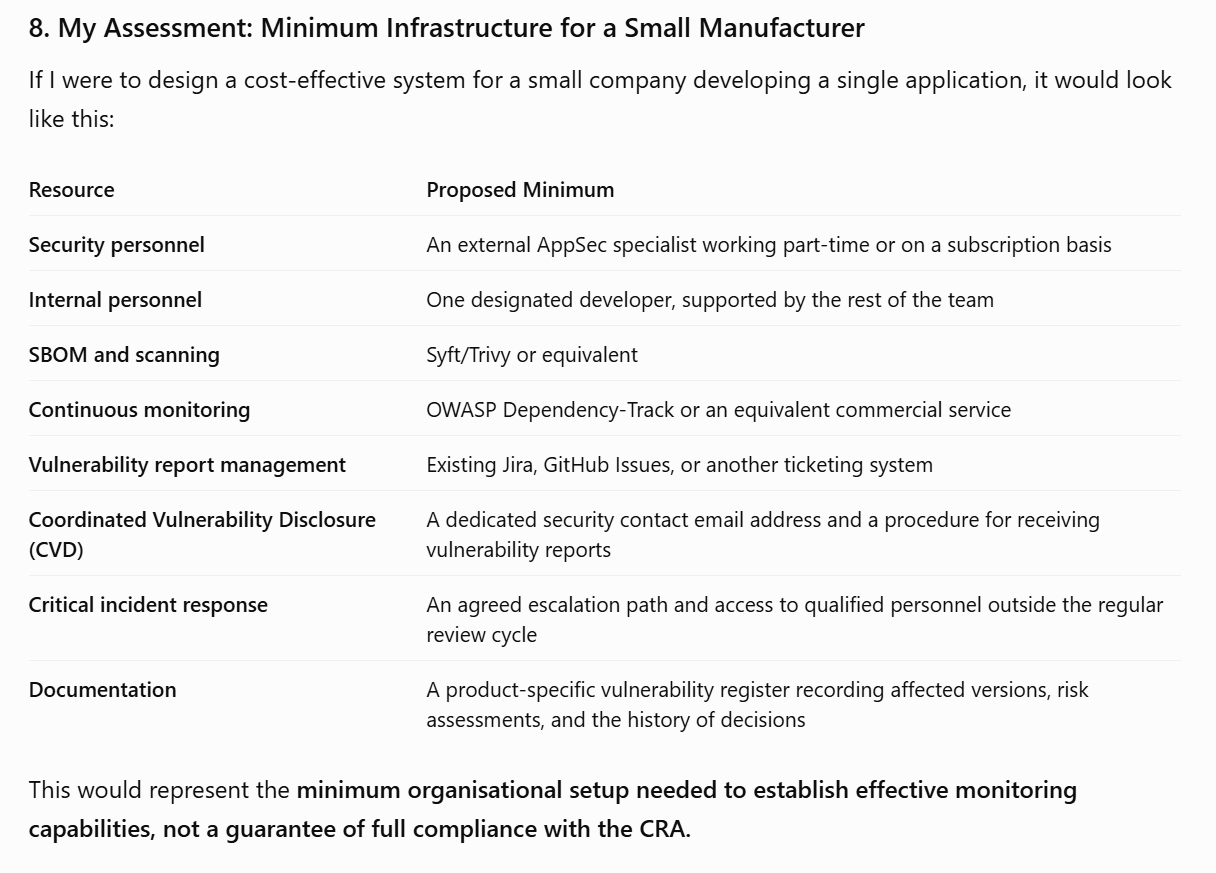
…and then expands on six pages .
Claude says (mind that at the end of the graph Claude makes a mistake regarding the starting date for incident and vulnerability notification. The right one is 11 September 2026):
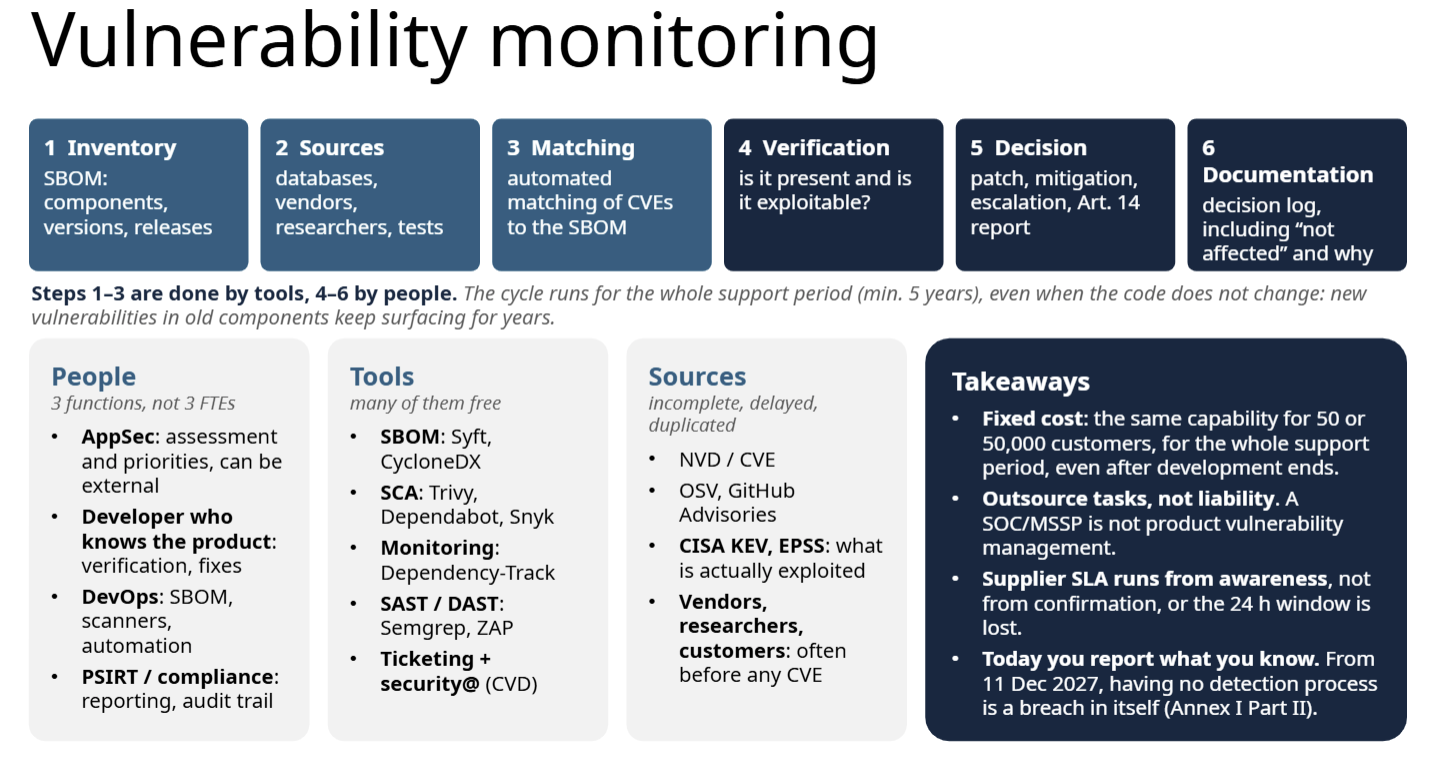
10.14. Support period (13(8) CRA)
Manufacturers shall determine the support period so that it reflects [1] the length of time during which the product is expected to be in use, taking into account, in particular, [2] reasonable user expectations, [3] the nature of the product, including [4] its intended purpose, as well as [5] relevant Union law determining the lifetime of products with digital elements.
When determining the support period, manufacturers may [does this mean that they may choose not to? 🤔] also take into account [1] the support periods of products with digital elements offering a similar functionality placed on the market by other manufacturers, [2] the availability of the operating environment, [3] the support periods of integrated components that provide core functions and are sourced from third parties as well as [4] relevant guidance provided by the dedicated administrative cooperation group (ADCO).
And to top it all off: The matters to be taken into account in order to determine the support period shall be considered in a manner that ensures proportionality.[?]
BUT
A MINIMUM OF 5 YEARS
unless it is expected [that is, who expects this?] that a product with digital elements will be used for less than five years, in which case the support period corresponds to the anticipated period of use.
10.15. 10 years of security update availability (13(9) CRA)
Manufacturers should ensure that each security update, as referred to Part II, point (8) of Annex I, which has been made available to users during the support period, remains available after it has been issued for a minimum of 10 years or for the remainder of the support period, whichever is longer
10.16. Backward compatibility (13(10) CRA)
Provision:
- Where a manufacturer has placed subsequent substantially modified versions of a software product on the market, that manufacturer may ensure compliance with the essential cybersecurity requirement set out in Part II, point (2), of Annex I only for the version that it has last placed on the market, provided that the users of the versions that were previously placed on the market have access to the version last placed on the market free of charge and do not incur additional costs to adjust the hardware and software environment in which they use the original version of that product
Explain this to me, Chat, using the iPhone X as an example
If the iPhone X were launched in 2028:
- Scenario 1: iOS 17 does not work on the iPhone X. The iOS 17 update is free, but to use it, the user must buy a new phone. This is a textbook example of an ‘additional cost associated with adapting hardware’. Apple must continue to provide updates for iOS 16 on the iPhone X for the entire support period, i.e. at least 5 years. In reality, this period is longer for mobile phones: the Regulation on the eco-design of smartphones (2023/1670) requires system updates to be provided for 5 years after a model is withdrawn from sale.
- Scenario 2: a banking app on the iPhone X. This is where things get most interesting for your audience. The bank – or, more precisely, the app developer – is a separate entity from PDE Banking. Let’s assume it releases ‘Banking’ v8 with a minimum requirement of ‘iOS 17’. In that case, a customer with an iPhone X won’t be able to install ‘Banking’ v8 without buying a new phone, so the cost condition isn’t met again. The bank must continue to patch ‘Banking’ v7 for iOS 16 until the end of the v7 support period.
Therefore, if we have released a product with software – for example, a smartphone version – then when our latest operating system no longer runs on that smartphone, we must maintain the security of the latest version of the operating system that does run on that smartphone.
But it gets even better. If we have released a utility app for a particular smartphone, we must maintain the security of the latest version of our app that still runs on that smartphone for 5 years.
10.17. Versioning (13(14),(15),(16) CRA)
Manufacturers shall ensure that procedures are in place for products with digital elements that are part of a series of production to remain in conformity with this Regulation.
Changes to the PDE that do not comply with the CRA process are subject to a Higher Penalty (15M/2.5%).
What should be done, according to Chat?
- a)Manage the change, ensure accountability for changes (signing off) and protect against malicious code or component substitution (SolarWinds) – supply chain security.
- b)Mark PDEs with version numbers / serial numbers (13(15) CRA)
- c)Indicate the manufacturer on the PDE and provide a website for contact (13(16) CRA ‘where applicable’ – does that mean always?)
10.18. Archives of previous versions (13(11) CRA)
Manufacturers may maintain public software archives enhancing users’ access to historical versions. In those cases, users shall be clearly informed in an easily accessible manner about risks associated with using unsupported software.
This means the archive should be divided into supported and unsupported versions, and this distinction must be kept up to date.
But are they allowed not to maintain one? Yes, they are. For B2C, it probably isn’t cost-effective to do so.
NOTE: a public repository for security updates is mandatory. Only the repository for archived versions of PDE software is optional.
10.19. Single point of contact for users
Manufacturers must maintain a single point of contact for users.
A single point of contact shall allow users [1] to choose their preferred means of communication and [2] shall not limit such means to automated tools – in other words, there must also be a person who reads and responds to these emails and other messages.
10.20. Information and instructions to the user
The information and instructions to the user set out in Annex II, must be available, in electronic or paper form, for 10 years after the product with digital elements is placed on the market or for the duration of the support period, whichever is longer.
In accordance with Annex II, ‘INFORMATION AND INSTRUCTIONS TO THE USER’, a product with digital elements must be accompanied by at least the following information:
- 1)[1] the name, registered trade name or registered trademark of the manufacturer, and [2] the postal address, [3] the email address or other digital contact as well as, where available, [4] the website at which the manufacturer can be contacted;
- 2)[5] the single point of contact where information about vulnerabilities of the product with digital elements can be reported and received, and where the manufacturer’s policy on coordinated vulnerability disclosure can be found;
- 3)[6] name and type and any additional information enabling the unique identification of the product with digital elements;
- 4)[7] the intended purpose of the product with digital elements, including [8] the security environment provided by the manufacturer, as well as the product’s essential [9] functionalities and [10] information about the security properties;
- 5)[11] any known or foreseeable circumstance, related to the use of the product with digital elements [12] in accordance with its intended purpose or under conditions of [13] reasonably foreseeable misuse, which may lead to significant cybersecurity risks;
- 6)[14] where applicable, the internet address at which the EU declaration of conformity can be accessed;
- 7)[15] the type of technical security support offered by the manufacturer and [16] the end-date of the support period during which users can expect vulnerabilities to be handled and to receive security updates;
- 8)[17] detailed instructions or an internet address referring to such detailed instructions and information on:
- a)[18] the necessary measures during initial commissioning and throughout the lifetime of the product with digital elements to ensure its secure use;
- b)[19] how changes to the product with digital elements can affect the security of data;
- c)[20] how security-relevant updates can be installed;
- d)[21] the secure decommissioning of the product with digital elements, including [22] information on how user data can be securely removed;
- e)[23] how the default setting enabling the automatic installation of security updates, as required by Part I, point (2)(c), of Annex I, can be turned off;
- f)where the product with digital elements is intended for integration into other products with digital elements, [24] the information necessary for the integrator to comply with the essential cybersecurity requirements set out in Annex I and the documentation requirements set out in Annex VII.
- 9)If the manufacturer decides to make available the software bill of materials to the user, [25] information on where the software bill of materials can be accessed.
10.21. Product correction or withdrawal 13(21) CRA
Non-compliance of the PDE or the processes put in place by the manufacturer with the ‘essential cybersecurity requirements in Annex I’ during the support period gives rise to an obligation to take corrective measures without delay:
- 1)ensuring compliance
- 2)withdrawal of the product from the market
- 3)recalling it from users
In other words, if things are not right, you have to make them right.
10.22. Cessation of operations 13(23) CRA
The manufacturer shall notify the market surveillance authorities and users of the impending cessation of operations, by all available means.
The obligation may not be enforceable in the event of insolvency; however, it must be taken into account in the case of liquidation.
And what is an importer or a distributor supposed to do with such a PDE? The importer and distributor remain liable for their obligations. So, they too must ensure that things are put right: fix, recall, recover.
10.23. Reporting incidents and vulnerabilities
10.23.1. Notification of vulnerabilities and incidents under Article 14 – an overview
❗Already in force❗
The reporting obligation covers actively exploited vulnerabilities and severe incidents having an impact on the security of the products, including those relating to PDEs placed on the market before 11 December 2027.
- (1)Early warning notification: 24 hours from the manufacturer becoming aware
- (2)Vulnerability or incident notification: 72 hours
- (3)Final report in the case of a vulnerability: 14 days from the release of the security update.
- (4)Final report in the event of an incident: one month from the 72-hour notification.
Contracts with developers, importers and distributors, as well as with authorised representatives, should include a provision requiring them to inform the manufacturer without delay of any incidents or vulnerabilities of which they become aware, within a timeframe that allows the manufacturer to meet the statutory deadlines.
What incidents and vulnerabilities must a developer report to the manufacturer?
At the very least, they must certainly report actively exploited vulnerabilities and severe incidents having an impact on the security of the PDE. However, consideration should also be given to the obligation to report
- (1)other vulnerabilities besides those actively exploited, e.g. ‘exploitable vulnerabilities’ (in accordance with Article 3(41) of the CRA, an ‘exploitable vulnerability’ means a vulnerability that has the potential to be effectively used by an adversary under practical operational conditions)
- (2)and about incidents other than severe ones.
Such additional reporting, however, would place the burden on the manufacturer to independently assess the reported incident and vulnerability.
What is the time limit for notifying the manufacturer?
The time limit for the manufacturer begins to run when they “become aware”. Therefore, the period during which the developer (or another party notifying the manufacturer) was aware of the issue is unlikely to be included in the time limit for the manufacturer. However, to demonstrate due diligence, one cannot allow for an excessively long period for ‘contractual’ notification. Since the manufacturer has 24 hours, it is likely that the same 24-hour period should be applied for notifying the manufacturer.
What does ‘of which it has become aware’ mean? We discuss this in more detail below.

10.23.2. Severe incidents and actively exploited vulnerabilities (14(1)–(3) CRA)
The manufacturer shall notify
- 1)[1] actively exploited [2] PDE vulnerabilities
- 2)[1] a severe [2] incident [3] having an impact on the security of the PDE
to the designated CSIRT and to ENISA,
via the single reporting platform https://portal.cra-srp.enisa.europa.eu/.
This obligation ALREADY applies, i.e. from 11 September 2026.
10.23.3. What is an ‘incident’?
Incident – the NIS21 definition adopted by the CRA:
- ‘incident’ means an event compromising the availability, authenticity, integrity or confidentiality of stored, transmitted or processed data or of the services offered by, or accessible via, network and information systems;
NIS2 and the CRA therefore define an ‘incident’ in terms of its RESULTS. There must be a breach of an information security attribute or business continuity. Just as the GDPR defines a ‘data breach’ in terms of its RESULTS.
10.23.4. What is a ‘severe incident’?
In accordance with Article 14(5) of the CRA
- For the purposes of notification, an incident having an impact on the security of the product with digital elements shall be considered severe if:
- a)[1] it negatively affects or
- [2] is capable of negatively affecting
- [3] the ability of a product with digital elements to protect the availability, authenticity, integrity or confidentiality of sensitive or important [4] data or [5] functions; or
- b)[6] it has led or
- [7]is capable of leading to
- [8]the introduction or [9] execution of malicious code [10] in a product with digital elements
- or [11] in the network and information systems of a user of the product with digital elements.
10.23.5. And here lies the pitfall…
A severe incident is also the one that MAY have a negative impact or MAY lead to the execution of malicious code. But this is still a RESULT-BASED event (because a severe incident remains an incident). It is one thing to know that an incident has occurred, and quite another to know what effects it may have.
The full definition of a severe incident, combining the definition of ‘incident’ from Article 6(6) of NIS2 and the definition of ‘severe incident’ from Article 14(5) of the CRA:
- an event compromising the availability, authenticity, integrity or confidentiality of stored, [2] transmitted or processed data or of [3] the services offered by, or accessible via, network and information systems, [4] having an impact on the security of the product with digital elements, where
- a)it negatively affects or is capable of negatively affecting the ability of the product with digital elements to safeguard the availability, authenticity, integrity or confidentiality of sensitive or important data or functions; or
- b)it has led or is capable of leading to the introduction or execution of malicious code in a product with digital elements or in the network and information systems of the user of the product with digital elements
10.23.6. What is a vulnerability?
According to the definition set out in Article 3(40) of the CRA
- ‘Vulnerability’ means a weakness, susceptibility or flaw of a product with digital elements that can be exploited by a cyber threat.
So, a vulnerability is a vulnerability.
According to the definition set out in Article 3(42) of the CRA
- ‘actively exploited vulnerability’ means a vulnerability for which [1] there is reliable evidence that [2] a malicious actor
- [3] has exploited it in a system [4] without permission of the system owner
A vulnerability is also defined in terms of its results, as it must be ‘actively exploited’. However, there is a specific, fundamental difference between the definitions of a severe incident and an actively exploited vulnerability.
The definition of an actively exploited vulnerability states that there must be ‘reliable evidence’ that it has (1) been actively exploited (2) by a malicious actor. ‘Reliable evidence’ means that we do not necessarily need to be certain as to whether the vulnerability is actually being actively exploited. ‘Reliable evidence’, which may consist of circumstantial evidence, is deemed sufficient. We should also assess whether this “active exploitation” was carried out with malicious intent. Information from someone who identifies themselves as an “ethical hacker”, or where such a role is implied by the context of the information, does not qualify as evidence that the vulnerability is being exploited by someone acting with malicious intent.
- However, we must be cautious here, bearing in mind that a few years ago, Uber’s CIO was reportedly convicted for classifying a ransom payment to hackers as a reward under the ‘Bug Bounty’ programme, thereby concealing the fact that their systems had been hacked. The CIO was acting in the company’s best interests. However, the matter came to light when Uber’s CEO changed. The new CEO clearly did not want to take the blame for the previous management’s manipulation. Or perhaps he was simply looking for an excuse to appoint his own CIO? We are familiar with similar cases from our own experience. As we know, there are no friends in corporations.
In the event of a severe incident, the CRA does not refer to ‘reliable evidence’. This indicates that, with regard to the incident, we must be certain that there has been a breach of the availability, authenticity, integrity or confidentiality of data or services.
10.23.7. What does it mean to ‘become aware’ of a severe incident or an actively exploited vulnerability?
Given the differences outlined above between the definitions of an ‘incident’ and a ‘severe incident’ on the one hand, and the definition of an ‘actively exploited vulnerability’ on the other, the moment at which the manufacturer ‘becomes aware’ of the problem must be assessed somewhat differently.
Formally, in case of a severe incident, the CRA requires for the incident to be established (in line with the definition of an incident referring to NIS2). That is to say, it must be certain that unauthorised activities have taken place. We assess the severity of the incident not only on the basis of the actual consequences but also the potential results.
By contrast, the definition of a vulnerability implies a hypothesis. That is to say, there is a way to exploit it in a manner inconsistent with the declared characteristics of a product with digital elements. As for whether it is ‘actively exploited’ and whether we are dealing with exploitation ‘with malicious intent’ (as well as without permission of the system owner), ‘reliable evidence’ is sufficient.
In practice, there will not necessarily be a distinction between certainty that an incident has occurred and reliable evidence of the active exploitation of a vulnerability by a malicious actor without permission of the system owner. Regulatory authorities understandably tend to focus on the credibility of the risk rather than the certainty of the event’s occurrence. Therefore, invoking the lack of sufficiently reliable evidence that a (severe) incident has occurred is probably best left to the stage of legal defence against sanctions imposed by the market surveillance authority.
10.23.8. Notifying users of severe incidents and actively exploited vulnerabilities
In accordance with the first sentence of Article 14(8) of the CRA,
- After
- [1]becoming aware of an actively exploited vulnerability or a severe incident having an impact on the security of a product with digital elements, the manufacturer
- [2]shall inform the impacted users of the product with digital elements and, where appropriate,
- [3]all users, of that vulnerability or incident and, where necessary,
- [4]of any risk mitigation [measures] and
- [5]corrective measures that users can deploy to mitigate the impact of that vulnerability or incident, where appropriate,
- [6]in a structured, machine-readable format that is easily automatically processable.
In accordance with the second sentence of Article 14(8) of the CRA,
- Where the manufacturer fails to inform the users of the product with digital elements in a timely manner, the notified CSIRTs designated as coordinators may provide such information to the users when considered to be proportionate and necessary for preventing or mitigating the impact of that vulnerability or incident.
The ‘time limit’ for informing users stems from Article 14(8), second sentence, of the CRA, which refers to a situation where the manufacturer has not notified users ‘in a timely manner’. These are therefore not rigid timeframes. A delay in providing information may, for example, stem from the assessment that informing a wide audience of a vulnerability before it has been patched would pose an even greater risk. This is all the more so given that the notification to users should include mitigating and remedial measures. These, of course, must be determined in first.
11. Voluntary reporting (Article 15 of the CRA)
In accordance with Article 15 of the CRA, anyone may voluntarily notify vulnerabilities and cyber threats to the PDE that could affect the risk profile of a product with digital elements, including on a confidential basis, either directly to the manufacturer or to the CSIRT designated as the coordinator or to ENISA, regarding any vulnerabilities contained in a product with digital elements, as well as cyber threats. The reporter may request that their identity remain confidential.
This is a significant provision, as it is not uncommon for corporations not only to fail to respond to vulnerability reports but even to take legal action against the reporters.
12. Importers, distributors and authorised representatives
Apart from the manufacturer, the key roles under the CRA are those of the importer, distributor and authorised representative.
The CRA sets out the obligations of importers and distributors much more briefly than those of manufacturers. However, there are pitfalls hidden within these obligations.
The main pitfall is the obligation for the importer to verify that the PDE is compliant, and for the distributor to verify that the manufacturer and importer have fulfilled their obligations. It will likely be easier to verify the compliance of a PDE that has been certified with the involvement of a notified body.
The second pitfall is the obligation to respond to the risk of product non-compliance.
12.1. Importers
In accordance with Article 19 of the CRA, an importer must:
- 1)verify that the PDE complies with the essential cybersecurity requirements set out in Part I of Annex I
- 2)verify that the vulnerability handling processes put in place by the manufacturer comply with the essential cybersecurity requirements set out in Part II of Annex I
- 3)verify that the manufacturer has drawn up the technical documentation for the PDE
- 4)receive and retain the technical documentation for the PDE
- 5)check whether the PDE bears the CE marking
- 6)check whether the PDE bears a type, batch or serial number marking (in accordance with 13(15) CRA)
- 7)check whether the PDE’s packaging meets the requirements of the CRA (in accordance with 13(16) CRA)
- 8)check whether the PDE has the information and instructions to the user (in accordance with 13(18) CRA) – NOTE – this requirement is not included in the checklist for the importer, but it is included in the checklist for the distributor and is a requirement for the PDE itself, so the importer must also check this
- 9)check that the end-date of support period is correctly specified, including confirming that the PDE they are importing still has at least one year and one month of support remaining (in accordance with 13(19) CRA)
- 10)check whether the PDE is accompanied by an EU declaration of conformity or a simplified EU declaration of conformity – NOTE – whilst this requirement is not included in the checklist for the importer, it is included in the checklist for the distributor and is a requirement for the PDE itself; therefore, the importer must also check this
- 11)if the importer ‘considers, or has reason to believe, that the PDE is non-compliant or that the processes put in place by the manufacturer are non-compliant, the importer is obliged to
- a.refrain from placing the PDE on the market until the PDE has been brought into conformity (19(3), first sentence, CRA)
- b.inform the manufacturer and the market surveillance authorities if the product with digital elements presents a significant cybersecurity risk (second sentence of the Article 19(3) CRA)
- c.where the importer has reason to believe that a product with digital elements may present a significant cybersecurity risk in in light of non-technical risk factors, the importer shall inform the market surveillance authorities to that effect (Article 19(3), paragraph 2 of the CRA). This refers to Recital 58 of the CRA – the risk of technological espionage, the risk posed by third-country legislation, and the risk of cybercrime, including threats to the supply chain (Article 19(3), second paragraph, of the CRA).
- 12)indicate their name, registered trade name or registered trademark and contact details on the PDE (19(4) CRA)
- 13)if an importer knows or has reason to believe that a product with digital elements which they have placed on the market is non-compliant (Article 19(5), paragraph 1 of the CRA), the importer is obliged to:
- a.immediately take the corrective measures necessary to ensure the PDE’s compliance, or to withdraw the PDE from the market, or to recall it
- b.inform the manufacturer of the vulnerability without undue delay upon becoming aware of the product’s vulnerability (Article 19(5), paragraph 2, sentence 1 of the CRA)
- c.inform the market surveillance authorities if a product with digital elements presents a significant cybersecurity risk, and provide the authorities with detailed information, in particular on the non-compliance and any corrective measures taken (Article 19(5), paragraph 2, sentence 2 of the CRA)
- 14)keep the technical documentation and the declaration of conformity for 10 years and make them available to the market surveillance authorities (Article 19(4) of the CRA)
- 15)provide market surveillance authorities with ‘all information and documentation’ (Article 19(7) of the CRA)
- 16)inform the market surveillance authorities and users that the manufacturer has ceased its operations (Article 19(8) of the CRA).
The contract between the manufacturer and the importer must specify the manufacturer’s obligations necessary to fulfil the importer’s obligations, as well as the procedures for their implementation. The consequences of non-compliance must be specified. It is also important to consider the implications for the importer should the manufacturer fail to fulfil its obligations, and whether any measures can be taken in advance to address this. The importer must also establish and implement procedures to verify compliance with, and readiness to fulfil, its statutory obligations.
12.2. Distributors
In accordance with Article 20 of the CRA, distributors must
- 1)act with due care in relation to the requirements of the CRA (20(1) CRA)
- 2)check that the PDE bears the CE marking (20(2)(a) CRA)
- 3)check whether the PDE bears a type, batch or serial number marking (in accordance with 13(15) CRA)
- 4)check that the PDE’s packaging meets the requirements of the CRA (in accordance with 13(16) CRA)
- 5)check that the PDE has the information and instructions to the user (in accordance with 13(18) CRA)
- 6)check that the end-date of the support period is correctly specified, including confirming that the PDE they distribute still has at least one year and one month of support remaining (in accordance with 13(19) CRA)
- 7)check whether the importer has correctly marked the PDE (in accordance with Article 19(4) of the CRA)
- 8)check whether the PDE is accompanied by an EU declaration of conformity or a simplified EU declaration of conformity (in accordance with 13(20) CRA)
- 9)check whether the manufacturer and importer have provided the distributor with all the necessary documents (20(2)(b) CRA)
- 10)Before placing the PDE on the market: if a distributor ‘on the basis of the information in its possession considers or has reason to believe’ that the PDE is non-compliant or that the processes put in place by the manufacturer are non-compliant, the distributor is obliged (20(3) CRA) to:
- a.refrain from making the PDE available on the market until it is compliant (20(3), paragraph 1, sentence 1 of the CRA),
- and, in addition, if the product with digital elements poses a significant cybersecurity risk,
- b.to inform the manufacturer without undue delay (20(3), paragraph 1, second sentence of the CRA)
- 11)once the PDE has been made available on the market (20(4) CRA):
- a.ensure that the corrective measures necessary to ensure the conformity of the PDE or the processes put in place by the manufacturer are implemented, or that the PDE is withdrawn from the market or recalled, if “the distributor knows or has reason to believe that the PDE made available by them is non-compliant or that the processes put in place by the manufacturer are non-compliant, the distributor is obliged (20(4) CRA)
- b.upon becoming aware of a vulnerability in the PDE
- c.inform the manufacturer without undue delay of the vulnerability of the PDE (20(4), second paragraph, CRA)
- d.notify the market surveillance authorities of the Member States in which the PDE has been made available on the market, if the PDE poses a significant cybersecurity risk, providing detailed information, in particular regarding the non-compliance and any corrective measures taken
- NOTE: prior to making the PDE available on the market, the distributor is already obliged to act when it ‘considers or has reason to believe’ that there is a problem; and after making it available, when it ‘knows or has reason to believe’
- 12)provide the market surveillance authority with all information and documentation necessary to demonstrate the conformity of the PDE and the processes put in place by the manufacturer in a language that can be easily understood by that authority (20(5) CRA) and cooperate with the authority
- 13)inform the market surveillance authorities and users that the manufacturer has ceased its operations (20(6) CRA)
12.3. When does an importer, distributor or other person become a manufacturer?
An importer or distributor becomes a manufacturer (21 CRA) if
- 1)they place a PDE on the market under their own name or trademark, or
- 2)makes a substantial modification to a PDE that has been placed on the market
If another person makes a substantial modification to a PDE, they also generally become a manufacturer (22 CRA).
12.4. Authorised representative (of the manufacturer)
- 1.A manufacturer may appoint an ‘authorised representative’ by a written mandate.
- 2.The minimum obligations of an authorised representative are:
- 1)retaining the EU declaration of conformity, [2] and the technical documentation available to market surveillance authorities for 10 years after the PDE has been placed on the market, or for longer if the support period ends later (e.g. if we place a PDE on the market but then introduce further types of PDE over the years);
- 2)providing the market surveillance authority with information and documents to demonstrate the PDE’s compliance;
- 3)cooperating with market surveillance authorities in activities aimed at eliminating the risks posed by a product with digital elements.
- 3.Is it worth being an authorised representative? It entails liability. In fact, it is unclear whether one can resign from the role, given that one’s details appear on the products and one is required to retain the documentation for 10 years.
- 4.Perhaps it would be worth appointing the importer as the authorised representative, given that the importer has broader obligations anyway?
- 5.As a manufacturer based in the EU, is it worth appointing a software developer as an authorised representative? It’s tempting, but there’s a risk to be considered, that the developer would act irresponsibly, and in particular that they would take the money but wouldn’t fulfil their obligations of authorised representative.
13. And what about open source?
- 1.In accordance with Article 3(48) of the CRA,
- ‘free and open-source software’ means software the source code of which is openly shared and which is made available under a free and open-source licence which provides for all rights to make it freely accessible, usable, modifiable and redistributable;
- 2.In accordance with Article 2(1) of the CRA, if PDE is not made available on the market – that is, in accordance with Article 3(22) of the CRA, it is not supplied for distribution or use on the Union market in the course of a commercial activity (whether for a payment or free of charge) – in other words, if it is made available essentially as a hobby or for ideological reasons, then it is not subject to the CRA. Examples of such non-commercial organisations would likely include the Tor Project for the Tor Browser and the Signal Foundation for Signal Messenger.
- 3.However, if an organisation or individual releases and monetises open-source software, it then becomes a manufacturer within the meaning of the CRA. An example of such an organisation would likely be Red Hat Enterprise Linux. Similarly, and perhaps even more so, Telegram.
- 4.The CRA distinguishes the role of an open-source software steward, which, in accordance with Article 3(14) of the CRA, means
- a legal person other than a manufacturer, that has the purpose or objective of systematically providing support on a sustained basis for the development of specific products with digital elements, qualifying as free and open-source software and intended for commercial activities, and which ensures the viability of those products
- 5.Open-source software stewards are not subject to administrative penalties (CRA 64(10)).
- 6.In accordance with Article 24 of the CRA, open-source software stewards shall put in place and document, in a verifiable manner, a cybersecurity policy:
- 1)to foster the development of a secure product with digital elements as well as
- 2)an effective handling of vulnerabilities by the developers of that product.
- 3)This policy shall also foster the voluntary reporting of as laid down in Article 15 by the developers of that product and
- 4)take into account the specific nature of an open-source software steward and
- 5)the legal and organisational arrangements to which it is subject.
- 6)This policy shall, in particular, include aspects related to documenting, addressing and remediating vulnerabilities and
- 7)promote the sharing of information concerning discovered vulnerabilities within the open-source community.
- 7.Open-source software stewards are obliged to cooperate with market surveillance authorities.
- 8.They are also obliged to report vulnerabilities to the extent that they are involved in the development of PDE (Article 24 of the CRA) and to report severe incidents, to the extent that these incidents affect the network and information systems provided by open-source software stewards for the purpose of developing PDE. This refers to PDE that constitutes open-source software.
14. Representative actions
Article 65 of the CRA
- Directive (EU) 2020/1828 shall apply to the representative actions brought against infringements by economic operators of the provisions of this Regulation that harm, or may harm, the collective interests of consumers.
We know how things stand with representative actions. Problems:
- 1)Claims under the CRA tend to be against the manufacturer, whilst sales are carried out by distributors.
- 2)The claimant will be required to prove that they have suffered material damage.
- 3)And then, of course, there are the courts.
15. Commission Guidelines
In accordance with Article 26 of the CRA, the Commission issues guidance.
Commission guidance on the application of Regulation (EU) 2024/2847 (Cyber Resilience Act)
https://eur-lex.europa.eu/legal-content/EN/TXT/PDF/?uri=OJ:C_202606013
https://cra.orcwg.org/official-guidance/
Time will tell whether it proves to be a treasure trove of knowledge or more of a hindrance than a help (a lifebuoy made of concrete, so to speak), as is so often the case with EDPB guidelines.
16. What should be done?
16.1. Notification of actively exploited vulnerabilities and severe incidents
The notification of actively exploited vulnerabilities and severe incidents is already mandatory.
- 1)Identify your status (manufacturer, importer, distributor, fulfilment service provider, public sector PDE contracting authority).
- 2)Identify the status of entities associated with your role.
- 3)Adopt and implement procedures for notifying vulnerabilities and incidents. Assign responsibilities to individuals.
- 4)Impose obligations on developers to report vulnerabilities and incidents.
- 5)Write to entities associated with our role within the CRA regarding the need to agree on cooperation procedures within the CRA by the end of November 2027. If we amend any contracts with them earlier, include a clause on commencing discussions regarding the CRA.
16.2. Remaining responsibilities by 11 December 2027
- 1)Draw up a comprehensive matrix of our responsibilities, which certainly comprises well over 200 checkpoints
- 2)Adopt appropriate regulations and assign roles
- 3)list all possible responsibilities for developers (companies that, for example, develop apps for us)
- 4)therefore, also include exit plans in contracts with developers to ensure PDE support is provided during the required support period
- 5)consider the release schedule for new versions of our apps, whilst assessing whether a new version falls within the full scope of CRA obligations or whether a risk assessment indicates that it may not yet do so (taking into consideration the Commision’s CRA Guidelines).
- * * *
About the author
Maciej Gawroński
Legal adviser. Expert in technology, litigation and regulatory matters.
Founder and managing partner of GP Partners. Previously, founder and managing partner of Bird & Bird Maciej Gawroński sp.k.
Winner of the 2021 M. Serzycki Award from the President of the Personal Data Protection Office.
Member of the Scientific Council of the Institute of Personal Data Protection Law at Vizja University.
Recommended arbitrator of the Court of Arbitration at the Polish Chamber of Commerce.
Supporting expert for the European Data Protection Board; European Commission expert on cloud computing contracts in 2014; expert for the Article 29 Working Party on international data transfers in 2014. Contributed to key provisions of the GDPR (Article 82(1) of the GDPR concerning the liability of data processors, Article 28(9) of the GDPR concerning the form of data processing agreements, and Article 22 of the GDPR concerning the right to data portability).
For over twenty years recommended by international legal rankings in the following categories: Data Protection, Disputes, Franchising, Intellectual Property, IT, Media, Patent Disputes in the Life Sciences, Trademark and Copyright Disputes, Technology, Telecommunications.
Lectured on cloud computing law, data protection, intellectual property and negotiation as part of postgraduate programmes at the Warsaw School of Economics and Łazarski University.
Editor and coauthor of the best-selling book on the data protection in Poland, Guide to the GDPR, and the best-selling book on persuasive litigation writing, Little Book on Drafting Pleadings. Co-author of over a dozen other books and more than a hundred legal articles in the fields of technology, copyright and directors’ liability. A popular speaker.
https://gppartners.pl/maciej-gawronski-pl maciej.gawronski@gppartners.pl

GP Partners Gawroński, Biernatowski sp.k. is an independent Polish business law firm based in Warsaw specialising in disputes, technology, transactions, procurement, corporate law, and regulatory matters. Founded in 2017 by Maciej Gawroński, a former managing partner at Bird & Bird, the firm has grown to a team of 19 lawyers in 2025.
Recognition. GP Partners is recognised not only for its expertise across several practice areas but also for its excellence in key qualities expected of professional advisers, including responsiveness, client service and communication skills.
- Rankings. GP Partners and its lawyers have been recognised by Chambers & Partners and other international rankings in the following categories: Data Protection, Disputes, Life Sciences Patent Disputes, Trademark and Copyright Disputes, Fintech, Franchise, Intellectual Property, IT, Public Procurement, Technology Media and Telecommunications, and, notably, Client Excellence. Apart from the regular recognition in Chambers Europe, In 2026 Chambers and Partners recognised GP Partners’ litigation practice in their prestigious Chambers Global Ranking.
- Bestsellers. Publications authored by GP Partners lawyers have topped Wolters Kluwer's bestseller lists in Poland, including: Guide to the GDPR (RODO. Przewodnik ze wzorami) No 1 Bestseller Wolters Kluwer 2018 and 2019); The Little Book on Drafting Pleadings (Jak pisać pisma procesowe i prowadzić komunikację w sporze czyli książeczka o pisaniu pism) No 1 Bestseller Wolters Kluwer 2022 (consistently in the Top 5 ever since); Przeciwdziałanie praniu pieniędzy oraz finansowaniu terroryzmu. Praktyczny przewodnik (Guide to the Anti-Money Laudenring Act) Wolters Kluwer Bestseller 2018.
- Awards. In 2021, Maciej Gawroński received the Award of the Polish Data Protection Office in recognition of his contribution to promoting knowledge about personal data protection.

- Directive (EU) 2022/2555 of the European Parliament and of the Council of 14 December 2022 on measures for a high common level of cybersecurity across the Union, amending Regulation (EU) No 910/2014 and Directive (EU) 2018/1972, and repealing Directive (EU) 2016/1148 (NIS 2 Directive) ↩